
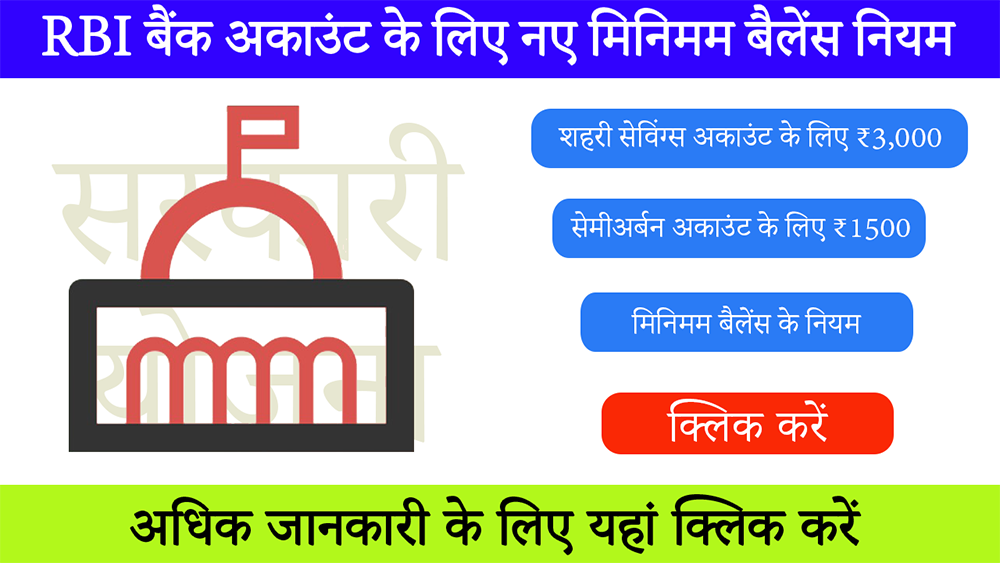
From January 2026 onwards, the banking landscape in India has seen key updates related to minimum balance requirements and associated policies, significantly affecting millions of savings account holders. These changes aim to improve customer protection, enhance transparency, and encourage financial inclusion.
New RBI Minimum Balance Rules: For millions of Indians, the humble bank account has quietly transformed from a place to park savings into a constantly moving hub of transactions. Salaries land, EMIs exit, UPI payments flicker through, and subscriptions renew without warning. Against this backdrop, the Reserve Bank of India’s revised minimum balance rules, effective January 20, 2026, mark more than a technical update. They signal a shift in how the central bank expects customers and banks to share responsibility in managing everyday banking.
What’s Changing for Savings Account Holders in 2026
For urban and semi-urban savings account holders, the update in 2026 is not really about an increase in the minimum balance amount. Most banks have already been maintaining a ₹3,000 average monthly balance requirement in metro and nearby city branches for some time.
What has changed is the growing need for customer awareness and financial tracking.
In today’s digital-first banking environment, money can leave your account much faster than expected. Auto-debit services, OTT subscriptions, food delivery platforms, UPI QR payments, utility bills, and EMI deductions can steadily reduce your account balance without any single large transaction. When these small deductions add up, your balance may drop below the required minimum — resulting in penalty charges that seem sudden but are actually pre-defined in the bank’s terms.
The key shift in 2026 is that account holders are now expected to actively monitor their balances, understand auto-debit commitments, and maintain a safety buffer to avoid charges. Banks emphasize transparency, but responsibility also lies with customers to keep track of daily digital spending.
Current Account Minimum Balance Rules and Their Impact on Businesses
The most noticeable impact of the updated banking framework is being felt by current account users. Small shop owners, independent professionals, freelancers, and MSMEs are now required to maintain higher average balances, typically ranging between ₹12,000 and ₹30,000, depending on the bank and branch location.
For many small businesses—such as a local kirana store or a single-person consultancy—this requirement means a portion of funds remains idle in the account. Money that could have been actively used for stock purchases, staff payments, daily operations, or promotional activities is effectively tied up. When balances fall short, penalty charges may be deducted regularly, gradually eating into profits without being immediately noticed.
Banks justify these higher balance requirements by highlighting enhanced service offerings. Maintaining larger balances enables them to provide quicker transaction settlements, business-friendly digital tools like integrated accounting platforms, and faster resolution of complaints.
According to fintech expert Rahul Deshpande, this shift reflects a move toward clearer pricing models. “In the past, businesses often paid the cost through delayed services or unclear fees. Now the pricing is upfront,” he explains. “While it may feel restrictive, it gives business owners a clear choice—either maintain the required balance for premium services or switch to more basic, lower-cost account options.”
Disclaimer:
This article has been prepared using publicly accessible information and a general interpretation of RBI guidelines and banking practices applicable as of January 2026. Minimum balance limits, service charges, penalty structures, and account facilities may differ based on the bank, type of account, and geographical location.
Readers are strongly encouraged to verify details directly with their respective banks or refer to official notifications for the latest and most accurate information. This content is provided solely for informational and educational purposes and should not be interpreted as financial, legal, or professional advice.